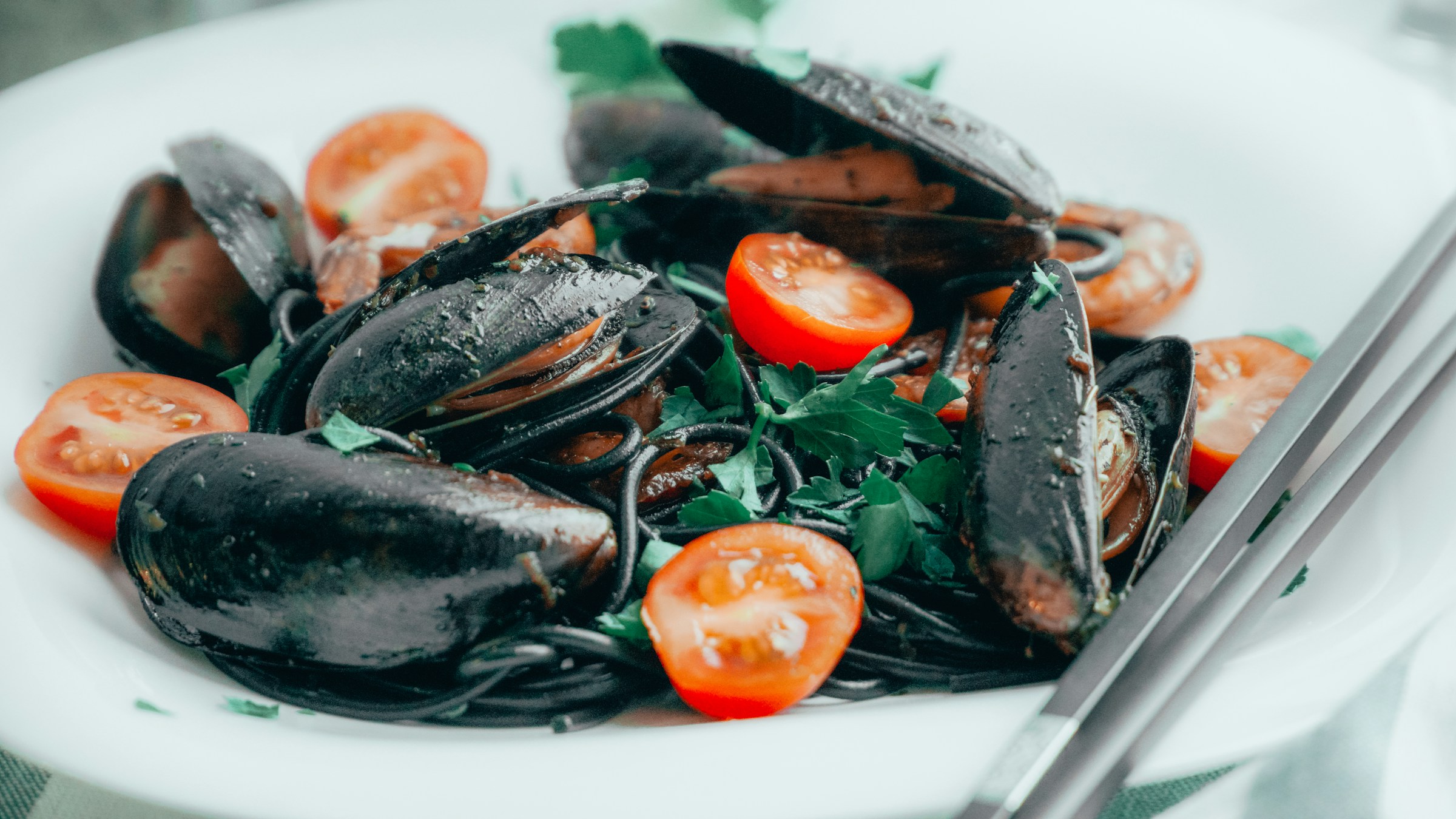
A mussel looks simple: two shells, a hinge, a briny smell that reads like “ocean” even before it hits a pan. But the modern mussel, especially the kind that travels from a protected cove to a restaurant hundreds of miles inland, is less a single ingredient than a stitched-together chain of timing, water, temperature, and paperwork. The “mussel map” is that chain: a living route that starts in plankton-rich seawater and ends as a tagged, chilled, traceable product.
For Pacific Seafood, mussels are both a global category (greenshell from New Zealand, blues from the Northeast, Mediterranean mussels from Washington) and a very specific place: Penn Cove Shellfishin Puget Sound. On Pacific’s brand page, Penn Cove shellfish are described as starting in hatcheries, then raised and harvested on farms in Washington, “never fed or fertilized.” The company places Penn Cove sites on its network map, alongside the company’s scale: “more than 40 facilities” and “more than 3,000 team members.”
This is a story about what happens between those points and why the details matter.
1) Growing Waters: Where Mussel Quality Begins
Penn Cove Shellfish describes itself as “the oldest mussel farm in North America,” tracing raft-culture experiments in Penn Cove back to the mid-1970s, “learning tide by tide” how to grow mussels in that specific water body. The company also puts a number on the operation: it “grows and harvests over two million pounds of mussels per year” from its Penn Cove farm.
That scale matters because mussels don’t behave like shelf-stable commodities. They’re alive at harvest, and their quality depends on what they were filtering recently, how quickly they’re cooled, and how consistently they’re held afterward.
Penn Cove’s own “Mussels” overview gives a more mechanical sense of how this farming works: springtime wild mussel spawn settles onto ropes, and rafts can support roughly 900–2,500 mussel “lines,” with up to ~50 pounds per line. That’s the farm as infrastructure, floating geometry designed to grow food.
2) The Tide Factor: Harvest Windows Aren’t Just Scheduling, They’re Quality Control
Tides aren’t a romantic detail here; they’re a constraint. Penn Cove’s legacy narrative emphasizes the practical learning curve “tide by tide,” which is another way of saying: your access, your workflow, and your time-to-ice window are never constant.
Penn Cove also notes that it maintains two 64-foot vessels to work the farm. Boats and tides are linked: calm water and workable currents make it easier to bring lines aboard, de-cluster mussels, and move product quickly back toward shore-side handling.
Here’s the quiet truth: for live shellfish, time is quality. The longer mussels sit warm after harvest, the faster you can lose the “fresh” you’re selling.
3) “Depuration Decisions”: When (And Why) Mussels Might Get a Controlled Cleanse
The word depuration is one of those industry terms that sounds technical because it is. Under the National Shellfish Sanitation Program (NSSP)definitions, “depuration” means reducing pathogens in shellstock using a controlled aquatic environment.
In practice, depuration tends to be a decision triggered by conditions, water classification, risk events, or operational needs rather than a default step for every mussel everywhere. When depuration is used, it also raises traceability stakes: NSSP guidance notes that depurated shellstock requires increased controls, including packaging/tagging to identify depuration cycles and prevent illegal commingling.
One commonly cited baseline in depuration research: when contaminated, many molluscs require ~48 hours of depuration at a minimum of 5°C to eliminate coliforms (the source notes challenges in colder regions). That’s not a promise that depuration solves every hazard; different pathogens behave differently, but it is a useful lens on what depuration really costs: time, infrastructure, monitoring, and paperwork.
So when I say “depuration decisions,” I mean this: there’s a fork in the mussel map where a lot number either moves straight into packing and distribution or detours into a controlled system designed to lower microbial risk, with stricter tagging requirements.
4) Flavor Is Seasonal Chemistry (And Harvest Timing Shows Up on the Plate)
A chef will tell you some mussels taste “sweeter” or “fuller” at certain times of year. Science backs up the idea that mussel flavor tracks physiology.
A classic paper on Mytilus edulis found glycogen in the soft tissues ranging from about 10% to 35% (dry weight) over the annual cycle, rising in spring/early summer and dropping toward a winter minimum. Glycogen is energy storage, but in shellfish, it’s also widely treated as a taste-relevant component (often associated with perceived sweetness/richness in sensory work on bivalves).
A separate study on seasonal taste chemistry in cultured mussels (Mytilus galloprovincialis) adds a more direct “flavor signal”:
- Meat yield ~30% for much of the year (with dips in winter months).
- Equivalent umami concentration (EUC) from July-October was 2–3× higher than November-April, and the authors conclude the “best season” is summer to early autumn, especially August-October.
You don’t need to eat only in August to care about this. For a company selling mussels year-round, the harvest calendar becomes part of product strategy: when to prioritize certain lots for premium live programs, when to route product for faster turns, and when to lean harder on cold-chain precision to preserve the best possible eating quality.
5) From Harvest to Customer: The 24-Hour Target and the Cold-Chain Reality
Penn Cove states it harvests year-round and can ship “to customers…within about 24 hours of harvest.” That is the kind of sentence that reads like marketing until you realize it’s also an operational benchmark. If you can consistently hit that window, you can sell freshness more honestly, with less need to “hide” behind sauce, steam, or branding.
But shelf life still depends on what happens after that first day. FoodSafety.gov’s cold-storage guidance notes that live clams, mussels, oysters, and scallops can be stored in a refrigerator at 40°F (4°C) or below for ~5–10 days. (That’s a safety/storage guideline, not a guarantee of peak quality; anyone who loves mussels will still tell you: sooner is better.)
Pacific Seafood positions the company as a national network again: 40+ facilities, broad distribution, and multiple Penn Cove locations on its map. In that context, “cold chain” isn’t a buzzword; it’s the only way the mussel map doesn’t break somewhere between dock and diner.
6) The Traceability Layer: The Map Isn’t Optional Anymore
Shellfish is one of the most regulated categories in seafood for a reason: it’s sometimes consumed raw, harvested from natural waters, and it can carry environmental signals (good and bad) from those waters.
NSSP materials emphasize traceability requirements like tagging and consistent harvest-location identification. The point isn’t bureaucracy for its own sake; it’s reconstructability. If a growing area closes or a risk emerges, regulators and buyers need to trace the product back through lots, harvest areas, and handling steps quickly.
That’s why, in a modern mussel story, “quality” isn’t just about taste. It’s also about whether the mussel has a defensible data trail, a map that can be audited.
Sustainability Isn’t Just a Claim Mussels Are Unusually Easy to Defend
One reason mussels have become a sustainability “darling” is that they don’t require feed inputs the way finfish do. Seafood Watch’s farmed mussels report gives a concrete rating outcome: a final score of 6.68/10 (Green range) and a Green “Best Choice” recommendation. Seafood Watch’s mussel recommendation page similarly states mussels farmed worldwide (bottom and off-bottom methods) are rated green, describing shellfish aquaculture as minimal-impact overall.
Pacific Seafood echoes that framing on its mussels page, noting that farmed mussels have earned a green Best Choice rating. And Pacific’s Penn Cove brand page explicitly uses Seafood Watch’s “Super Green” language for farmed bivalves (mussels, clams, oysters), emphasizing their health-and-environment profile.
The important journalistic move here is restraint: sustainable doesn’t mean risk-free, and “green-rated” doesn’t eliminate the need for water monitoring, toxin closures, and tight temperature control. It just means the farming method, in aggregate, is comparatively defensible.